Many AI safety discussion focuses on the model. Better training, better alignment, better guardrails embedded at inference time. That framing is reasonable for the people building foundation models. For the people deploying them under regulatory obligations, it is the wrong level of abstraction.
The model will make mistakes. It will hallucinate citations, misread context, reproduce statistical bias from its training distribution, and occasionally state something false with full confidence. No current model is immune to this. The relevant question for a compliance team is not how to prevent mistakes — it is whether your system can detect them, bound them, and demonstrate that it did.
That is a system design problem, not a model problem.
The loops that exist
A useful way to think about this: every AI deployment has a setpoint — something you want it to do — and outputs that may deviate from it. The engineering discipline is building feedback loops that catch and correct those deviations. Several types are in production use today.
Retrieval grounding is the most effective and most widely deployed. Rather than generating from memory, the model is constrained to what it can find in a defined knowledge source. Claims that are not supported by retrieved documents can be detected and rejected. Hallucination rates fall significantly — not to zero, but to a manageable level.
Critic models are a second pattern: a separate model evaluates the output of the first for factual accuracy, policy compliance, or bias. Where the critic flags a problem, the generator revises. This is structurally similar to a supervisory control loop — one agent checking the work of another before it leaves the system.
Confidence thresholds and abstention address a different failure mode: the model that does not know it does not know. A well-configured system estimates its own uncertainty and routes accordingly — abstaining, flagging for human review, or triggering additional retrieval when confidence falls below a defined level.
Monitoring and drift detection operate at a slower timescale. Logging outputs continuously, tracking hallucination rates, bias metrics, and distribution shifts over time — this is what allows retraining, rule updates, or system throttling to happen before problems compound.
What works, and what does not
Retrieval grounding, multi-step verification chains, and tool-assisted fact-checking — code execution, database queries, web search — reduce error rates meaningfully in practice. These are solved-enough problems that you can build production systems on top of them today.
The harder problems are worth naming plainly.
Models can confidently validate wrong answers. A critic model evaluating a hallucination may itself hallucinate a validation. "Hallucination detecting hallucinations" is a real failure mode, not a theoretical one. Multi-model consensus and tool verification reduce this risk; they do not eliminate it.
Bias detection requires normative definitions. Before you can measure bias, you have to decide what counts as bias in a given legal, cultural, and operational context. That is not a technical question. Different jurisdictions, different frameworks, and different use cases will give different answers.
Feedback instability is also real. Over-correction produces a system that is too cautious to be useful — it abstains on everything borderline, escalates constantly, and returns qualified non-answers. Under-correction produces a system that is unsafe. Calibration is continuous work, not a one-time configuration.
What the regulations actually ask for
ISO 42001 and the EU AI Act are sometimes read as requiring AI to be 100% reliable. That is not quite right. They require AI systems to be (risk) managed — which is a more achievable standard, and a different one.
"High-risk AI systems shall be designed and developed in such a way that they achieve an appropriate level of accuracy, robustness, and cybersecurity, and that they perform consistently in those respects throughout their lifecycle." EU AI Act, Article 15.1
The practical requirements are: documented controls, traceability from AI output to the evidence that supports it, human oversight mechanisms at defined points, and periodic evaluation and correction of the system. None of these require perfect outputs. All of them require auditable processes.
"Testing shall be carried out against prior defined metrics and probabilistic thresholds that are appropriate to the intended purpose of the high-risk AI system." EU AI Act, Article 9.8
"In addition, effective risk management of AI models is complicated by non-representative datasets, limited audibility and unclear allocation of responsibility or ownership across AI value chains." Report AI & Algorithms Netherlands, February 2026 — Department for the Coordination of Algorithmic Oversight (DCA), Autoriteit Persoonsgegevens
This distinction matters because it changes what you build. A perfect model is not a compliance target. A bounded, traceable, correctable system is.
FATE (FAccT)
FATE/FAccT-style principles are the normative and governance layer. They help define what counts as problematic behaviour and what obligations a system has, while monitoring and control loops are the operational layer that detects and responds to those problems.
Fairness sets the criteria for bias assessment, and those criteria are context-dependent rather than universal.
Accountability assigns roles, responsibilities, oversight, and response duties across the lifecycle, not only after harm occurs.
Transparency makes scrutiny and challenge possible by providing context-appropriate information about the system, its outputs, and relevant decision processes.
"Public trust in AI and algorithms remains fragile and closely linked to transparency." DCA Report, February 2026
Explainability does not require a model to expose private reasoning verbatim; it requires meaningful information about how outputs are produced, at a level suited to the audience and use case.
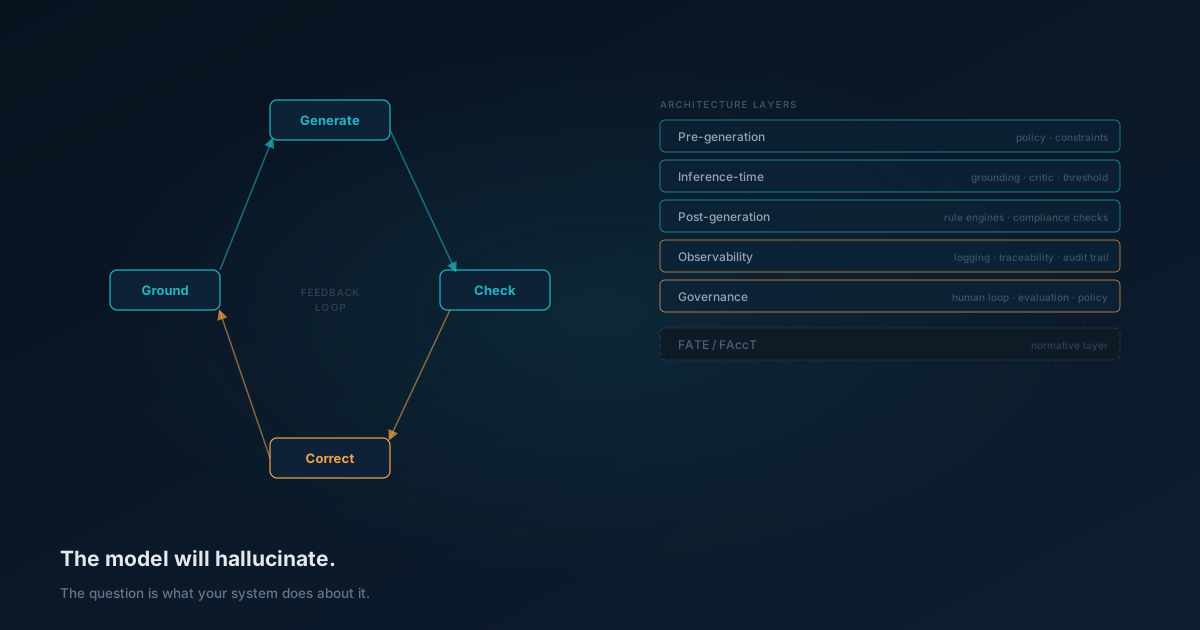
What a compliance-grade architecture looks like
Combining the layers in practice:
Pre-generation. Policy injection, context shaping, and prompt constraints establish what the model is and is not allowed to do before any generation happens. These are the hardest limits — the ones that do not depend on the model self-correcting.
Inference-time. Retrieval grounding anchors generation to a defined knowledge source. Critic models and tool verification catch deviations before output is accepted. Confidence thresholds route uncertain outputs to human review rather than allowing them to flow through unchecked.
Post-generation. Rule engines and compliance checks validate output against the specific requirements of the frameworks in scope — not generic safety, but the actual controls the organisation is accountable to.
Observability. Logging, traceability, and audit trails. Every output associated with the input that produced it, the retrieval that informed it, and the checks it passed or failed. Point-in-time reconstruction — the ability to show what the system said and why, at any past date — is what makes audit possible.
Governance. Human escalation paths, periodic evaluation cycles, policy update mechanisms. The loop that closes over weeks and months rather than milliseconds.
What Sovaign does here — and what it does not
| Layer | Sovaign |
|---|---|
| Retrieval grounding | The Advisor and AI features retrieve from the knowledge graph. Answers are anchored to actual evidence nodes, not generated from model memory. |
| Confidence thresholds | Conservative, moderate, and aggressive settings. The system flags or abstains below threshold rather than presenting uncertain outputs as settled. |
| Post-generation validation | AI-drafted content is mapped to framework obligations before it enters the graph as active evidence. The graph is the gate. |
| Audit trail and traceability | Every evidence node links to the obligation it satisfies via a documented reasoning chain. Point-in-time snapshots allow posture reconstruction at any past date. |
| Human-in-the-loop | Review and approval are required before content becomes active evidence. The model surfaces; the person decides. |
| Freshness and drift monitoring | Stale control and evidence detection — this is drift monitoring applied to compliance data. Controls that have not been reviewed and evidence that no longer meets its obligation are flagged continuously. |
| Model-level drift monitoring | Not in scope. Sovaign does not monitor the underlying AI models for degradation or distribution shift. That is upstream of what Sovaign manages. |
| Training-time loops | Not in scope. Model selection and training are outside the system boundary. |
The practical implication
The question for any organisation deploying AI under ISO 42001, NIS2, or the EU AI Act is not whether their model is safe. It is whether their system is bounded, observable, and correctable — and whether they can prove it.
That proof does not come from the model. It comes from the architecture around it.