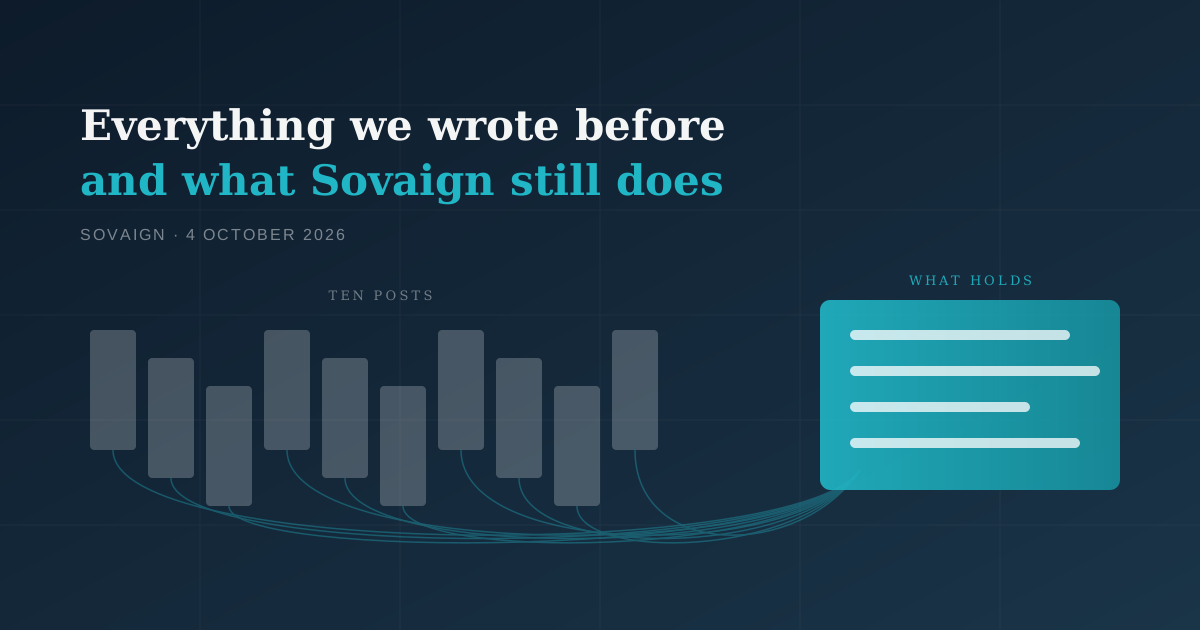
The early posts described a system that grew fast: a knowledge graph, a gateway to any model, an autonomous agent orchestrator, thirteen services. It worked well enough to show the idea. It did not hold up well enough to sign anything with. Over the summer we rebuilt Sovaign as a smaller, stricter engine, kept the ideas that proved themselves, and dropped the ones that did not. Here is the account.
The ideas that held
Accountability as infrastructure. Our first post argued that compliance documentation describes how an organisation should behave, while little of it proves how it does. AI widens that gap on both sides: organisations change faster, and scrutinisers can check more. That is still the reason Sovaign exists, and it is still the vision on our front page.
Obligations first, evidence discovered. In February we wrote that compliance should not mean filling in someone else’s template: start from what a framework requires and let AI find how your organisation already does it. That is exactly how Sovaign works today. It reads the documents and records you already have — handbooks, checklists, contracts, not only policies written for an auditor — and proposes what each one evidences.
The model will be wrong; the system must catch it. In March we argued that the question is not whether a model hallucinates but whether the system around it can detect, bound and demonstrate it. That principle now runs through everything: every citation is checked back against the source text, anything below a confidence floor reads as “cannot evaluate”, and nothing the AI writes counts until a named person approves it.
ISO 42001 is the next layer on ISO 27001. Our post on unacknowledged AI obligations said an AI management system shares its structure with an information security one, and that much of the evidence serves both. Sovaign now makes that concrete: an approved record counts, with the same citation, in every framework where the clause is genuinely shared. We run Sovaign’s own AI management system in Sovaign.
Agents need an accountability layer. We wrote about the open question of who is accountable when AI agents cooperate. Our answer, built into the product: agents are expected participants, but they propose and never decide. Every agent action is recorded against a named organisation and agent, and every decision carries a named person.
What Sovaign still does — and how it changed
| Then (early 2026) | Now (October 2026) |
|---|---|
| AI reasoning chains, approved by a person | Still the core. The AI reads your whole approved document set per requirement and proposes claims with verified citations; a reviewer approves, rejects or corrects each one. Approval pins the exact content approved. |
| Coverage per obligation | Sharper: evidence is judged for design, operation and effectiveness separately, and the result becomes a Statement of Applicability you sign with a passkey. |
| Snapshots to reconstruct a past date | Built in: any read can be asked “as of” a past state, so you can show what was known, and when. |
| Stale controls and drift alerts | Evidence now carries dates and ages: a lapsed management review or an unmeasured objective stops counting as operating. A webhook fires before evidence lapses. |
| Audit readiness score and letter grade | Replaced by one dashboard: green, amber, red and grey — where grey means “not known yet” and is never drawn green. |
| Conservative / moderate / aggressive AI modes | Replaced by one rule: below the confidence floor the verdict is “cannot evaluate”, never a guess. |
| Eleven functional roles | Four organisation roles — viewer, contributor, reviewer, administrator. Deciding needs a person present, signed in with a passkey. |
| MCP server, 32 tools, localhost | Public and standards-based: app.sovaign.com/mcp, with OAuth, so Claude, ChatGPT and other clients can connect with the same rules as the interface. |
| Document versioning and duplicate detection | Kept: a document keeps one identity across versions, a signature pins a revision, and documents are encrypted at rest with a key each — erasing one destroys its key. |
| Three frameworks | Five: ISO 27001, ISO 42001, ISO 9001, NIS2 and the Dutch Cyberbeveiligingswet. |
| “Your graph, your rules” — no lock-in | Stronger: your management system lives as plain files in its own git repository. You can export everything, re-host from the export alone, and an auditor can verify every approval without Sovaign running. |
| Neo4j knowledge graph | Gone. Files are the record; a Postgres index is rebuilt from them and checked on every change. |
| Gateway to any model, including local ones | Gone. Our January experiment with local models was useful, but quality decides here: the analysis runs on your organisation’s own AI API key — or ours, if you choose — with every call capped, recorded and evaluated. |
| Embedding search over chunks | Gone. We measured it finding 38% of the relevant evidence. Reading the whole approved document set finds far more. |
| SATO, the autonomous agent orchestrator | Gone. No agent loops run inside Sovaign. Your agents work from outside, and everything they write waits for a person. |
| Governance Pulse news scanning | Gone. A news feed that no decision depended on did not earn its place. |
| Advisor, policy generator, onboarding wizard, brochure | Gone. Sovaign proposes what your documents evidence and what is missing; it does not write your policies for you. |
What we got wrong
We were proud of the size of the old system. Size was the problem: the more services, roles and agents there were, the less anyone could say with certainty what a green meant. Three lessons drove the rebuild.
Measure before you believe. Embedding search looked like it worked until we measured it. Every prompt and model choice now has to pass an evaluation before it ships, and we publish our measured recall in the product’s intended-use statement.
Honest unknowns beat confident scores. A readiness score of 63 out of 100 invites the question “63 of what?” Sovaign now says what it knows, what it found wanting, and what it cannot evaluate — and a gap means “not yet found”, not “absent”.
Self-hosting is a choice, not the whole story. We wrote that your data never leaves your infrastructure. In the hosted version that is not quite true, and we say so: documents are stored and indexed in the EU, but the paid analysis sends your approved documents to the AI supplier your administrator recorded. You can still run Sovaign on your own server.
Where this leaves the old posts
They described a different system, so we have taken them down. Their arguments live on above; their architecture does not. For how to use Sovaign today — especially if you already work with AI assistants and agents every day — read the next post.